
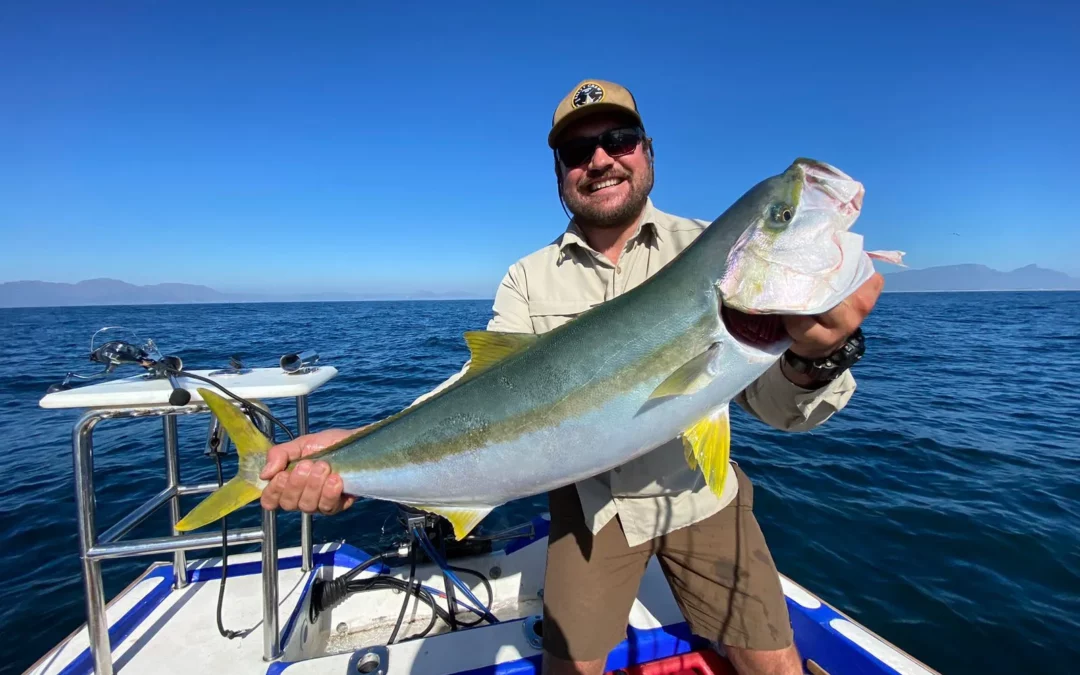
The Cape Yellowtail (Seriola lalandi), known locally as the Geelstert, is arguably Cape Town’s strongest pound-for-pound fighting fish.
These green-backed torpedoes are basically pure muscle. Whether they are boiling on the surface or making you work for a pull, they remain the ultimate prize. If you want to pull tail instead of just burning petrol, you need to understand their distribution, movements and seasons.
In the summer months, we tend to look for them around Cape Point, False Bay, and the Overberg. In the winter months, they frequent the West Coast fisheries like Dassen Island, Lamberts Bay and St. Helena Bay. But keep an eye out, these fish have a tendency to break the rules and can pop up anywhere at any given time, regardless of seasons.
When to Go Yellowtail Fishing: Seasons and Environmental Signs
Success at Cape Point and within False Bay isn’t just luck; it’s about either being well-connected with reports or being able to read conditions and charts – and it’s in your best interest to focus on the latter.
While yellowtail can be found year-round, the primary season runs from November through May. To find them, look for these three critical indicators:
Wind Patterns:
The South-Easterly is the engine. We want a few days of a strong SE wind to cause upwelling, followed by a South-Westerly push. This SW wind is the “magic hand” that moves the warmer, clean blue oceanic water back against the shore.
Although the South Easter may crush temperatures on the Western seaboard, it has a tendency to hold temperatures in the bay itself. Wind driven currents shift warmer water out the points at Hangklip and Cape Point.
When these warmer patches of water meet the cooler waters the magic starts to happen. Throw a bit of SW into the mix to straighten things out and to clean it up and we’re on !
Water Conditions:
Yellowtail are visual hunters. Try and find 17°C or higher and look for light-blue or greenish-blue water. They can be caught in water as cold as 14deg with some larger fish known to eat in water down to 12 deg, so it’s not all lost if you arrive at some icy temps, but they will make you work for it. Water clarity is vital for the fish to spot your lure.
If the water is brown or “ginger,” the fish might be there, but they’ll rarely feed on top. You may even see shoals sporadically feeding on the surface but when casting lures at them, they struggle to eat.
Look for a thermocline on your fish finder. Often, a bottom layer of cleaner water might be sitting below that ginger water, a patch that can be worked with vertical jigs or bait.
Natural Signs:
Watch the “sterretjies.” When these terns are dipping on the surface and skimming bait, it means yellowtail have pushed small bait balls to the surface. It’s not all about Sterretjies, though, so many anglers ignore the gulls and shearwaters.
Different species of sea-dwelling birds also follow the shoals from above. If you see birds like gulls, gannets or shearwaters turning over a patch, give it a try, you might be surprised as to what they are hovering over.
Floating tangled patches of uprooted kelp can also hold the odd yellowtail as it creates a little haven for baitfish to take refuge under. Casting along the edges of these flotillas of kelp can often produce a bonus fish.
Then, there are pressure edges: A fancy term that has confused many an angler.
Imagine placing a big rock in a stream. The water will bulge against the rock on the side that the stream is flowing, that’s the pressure edge of the structure. The upcurrent side of the structure (pressure edge) often holds the goods like bait fish or crustaceans that yellowtail are feeding on.
(Yes, crustaceans. Feeding on shrimp is a thing and while they are sometimes dubbed with lock jaw, it’s merely them feeding on tiny shrimp.) The same can be said for currents in the deep, where stronger current lines meet slacker water. Baitfish often hold close to these current lines.
Temperature gradients can also narrow down your search so keep an eye on your temperature readings when you catch your first fish of the day to start building a pattern.
Yellowtail Hotspots in the Cape
Cape Town anglers are blessed with world-class grounds. Here’s where we usually find the schools:
False Bay / Cape Point:
This is the heart of the action. Key spots include Buffels Bay, Anvil Rock, SW Reefs, Rocky Bank, Seal Island, and the legendary Bellows Rock.
Inside the Bay:
When the fish move deeper into False Bay, look at Whittal Rock, Seal Island, East and York Shoal, Gordon’s Bay reefs, even St. James, Kalk Bay, Fish Hoek and Simonstown.
West Coast:
Robben Island and Dassen Island are consistent producers on the Atlantic side, balancing out the Cape fishery well with better showings during the winter and spring months. More often than not having great showings in July and August. Lamberts Bay and St.Helena bay also have some outstanding catches at times.
Overberg:
Struisbaai, being the Mecca of all the yellowtail grounds in South Africa, is not the only spot where these fish can be found in the Overberg. Quoin Point, Pearly Beach, Gansbaai, Betty’s Bay, Hangklip and Rooi Els all have their spells; they can be trickier to fish for, as most of the time fish appearing in these zones are sporadically feeding as they are transitioning between major feeding areas.
Tackle Recommendations
Landing these powerful fish requires gear that will handle repetitive stress and pressure. There is gear that will last a season, and then there is gear that will last you a few seasons.
When fishing for gamefish, smooth, powerful drag systems, high-quality materials and reliability are what you want to focus on.
Here’s a list of trusted gear that is readily bought by our customers. All gear has been trialled and tested on yellowtail.
| Category | Recommended Model | Why It Works |
| Reels (Grinder/Spinner) | Shimano Saragosa, Shimano Twin Power, Shimano Stradic, Shimano Stella, Penn Slammer IV, Daiwa BG MQ, or Okuma Salina | High-performance drag systems to survive intense, long-running geelstert fights and salt water sealing for when things become a little bumpy and wet out there. |
| Lures | Seal Point Plugs, GT Ice Cream, CID Shiverstick (45g), Blu 2798 S-Spoon Chrome, Old Cape Secret 70 Spoons, CID Casting Sprat 90mm, Fishman Anchovey Sprat, Fishman Attack Sprat. Rapala XR Mag, Halco Laser Pro. Squids | Casting distance and action of the specifically mentioned lures is what makes this selection our regular buyers’ top choices.
Pink is a favourite colour for lipped lures. |
| Terminal Tackle | BKK Raptor 2/0 & 3/0
BKK Diablo Single 4/0 & 5/0 Owner ST 66 3/0 Mustad Treble Lok Jaw / Kaiju 2/0 & 3/0 Mustad Kaiju 4/0 & 5/0 Rockpoint 3/0-5/0 for spoons. SSH Trebles |
Yellowtail require reasonable force to either keep off the bottom or away from structure. Good hooks can make a serious difference in your tally for the day. |
| Swivels / lure clips | AFW Ball Bearing Swivels
Mustad lure clips |
Prevents line twist on lures. Lure clips can be of great use when changing out lures to find their preferred lure for the day. Saving you time from cutting down leaders and retying lures. |
| Leader | .60mm – .80mm
Maxima Ultra Green Double xx Maxima Fluoro Carbon Fishman Fluoro Carbon |
The sweet spot for leaders depends greatly on the shoal size of fish. For “maalkoppies” you can dip below .60. The general sweet spot sits around .60 to .70mm for Point fish.
120-180lb leader for large fish in foul terrain from shore. Leader quality can make a difference if the fish are shy. |
Mastering the Technique: Trolling, Spinning, and Baiting
Depending on the day, the fish might be “on the bite” or acting shy, and if there is a fish in this ocean that will drive you mad with lockjaw, it’s our beloved Geelstert.
You need to be ready to switch methods to try to crack that daily code. The die-hard spin fisherman will blank without batting an eyelid as they know all too well, when yellowtail shut down they emphasise the meaning of lock jaw.
It’s better to light the fire a little earlier and sink a few cold ones with family and friends.
Trolling
Trolling is an easy way of finding fish. A good trolling speed for yellowtail is around 5.5-6.5 knots SOG. If fish are in a frenzy, you can push it up to 7 knots, even pushing higher when fishing with skirts and feathers. While some Rapalas might be effective at 6.5 knots, smaller lipped lures might find their sweet spot at lower speeds, so pay close attention to how your spread is tracking at speed.
Sometimes you can tune a lipped lure with pliers by bending the eye in the opposite direction that its fading towards.
Your spread can greatly determine your success. Play around until you find something that works for you and runs true according to your boat. We recommend running two to four rods.
Two rods, one long shallow and one short deep. 4 rods. Left long shallow runner, left mid deep runner, right short deep runner, right short shallow. It’s easy to turn with your spread in this order if fish rise in close quarters preventing a spectacular tangle.
Adjust your spread and lures as the fish reveal their biting trend and preference for lures.
Spinning
Land Based
Undoubtedly, the most fun way of catching yellowtail is to actively spin for them from shore. Seeing those green backs pile up behind your plug or lure and then watching that white mouth inhale its prey and turn to give a stellar fight, it’s the ultimate shore-based gamefish in the Western Cape, apart from the unicorn Yellowfin that rarely makes an appearance.
With this comes a naturally protected fishery fiercely enforced by locals. There are local diehards in this game that either fish from shore or from ski boats, both of whom become besotted with the sport, defending their secrets with tooth and nail.
More protected than National State secrets are the zones and ledges that these anglers fish from, and if you are fortunate enough to enter that bubble, respect the hard yards that others have poured blood, sweat and tears into to pave a path of knowledge that many new generation anglers so effortlessly walk and thrive on.
The tackle you require for spinning from shore largely depends on the size of the fish you are targeting.
False Bay fish are generally smaller in size, rarely pushing the 10kg mark. The general rule of thumb is PE3 in the False Bay region. The higher up the coast you move, the greater the demand for PE6/8/10 becomes.
Sure, you’ll land them on lesser gear you will, but when the real ones pull in, you will be destroyed faster than what your feet can keep up with your drag pressure and that on PE10.
11-12ft rods still need some developing in terms of pulling power for these large specimens. However, they serve extremely well for False Bay fish. Up the coast, you can start using popping gear as the ledges are deep and fish move within proximity of the angler.
Offshore: Ski Boat
The Approach Rule: Never drive your boat through the middle of a feeding school. This “spooks” the fish and pushes them down. Instead, circle the edge of the school at a comfortable chasing distance and cast your spoon into the frenzy. Be mindful and respectful of other boats already engaged in a pocket of fish. Casting can, in certain areas, be done on the drift.
Often, those fish are sitting in a zone not quite showing themselves. Dropping your spoon/lure down and varying retrieve rates often raises fish where there were seemingly none. Be active and think outside of the box, which is often defined by chasing other boats and birds.
Jigging
Few anglers realise how deadly jigging can be for Yellowtail. More often than not, fish will sound around mid-morning and sit at a depth of 30-40m only to rise mid-afternoon again.
This is a great time to take out your jigs and work the patches that you marked. If you can get one to feed at depth, you’re likely to send a few more into a frenzy. Jigging on feeding fish can be extremely fun, and full-house hook-ups are quite common.
5-6ft 200-300gr light jigging setups can comfortably handle fish up to 15 kg. Modern technology is incredible on these pencil-thin rods! These fish prefer high-speed jigs and are more likely to bite lures that they need to give chase to. Pink, black/grey over silver, blues, greens and silver are all favourite colours.
Baiting
If the fish are holding deep or shy on the lures, the use of bait can be a blank-buster. Use an 8/0 – 10/0 hook with pilchard, pike, fresh Chokka or the gold standard: fresh octopus. Live Mackeral and maasbanker can do the trick on bigger specimens too.
Tip: Chokka can be freshly caught and is obviously a great bait for Yellowtail. Pick up some squid jigs from FG Tackle and catch your own fresh chokka. Nothing beats live or fresh bait when the Yellowtail are being fussy. Keep your drag tight; these fish will try to stitch you into structure the moment they feel the hook.
Rules of the Water: Limits and Conservation
Our Yellowtail stocks are healthy, currently listed as SASSI Green and a species of Least Concern, but they need our respect to stay that way.
- Bag Limit: Recreational permit holders are limited to 10 Yellowtail per person per day. Limit your catch, don’t catch your limit.
- Size Limit: While there is no legal minimum size (as per ORI), we recommend letting the smaller juveniles grow to ensure the future of the fishery.
- Permits: Always carry your recreational sea fishing permit. If you decide to head inland for species like the indigenous Clanwilliam Yellowfish, remember that a CapeNature freshwater angling license is a legal requirement for anyone over six.
Cooking Your Yellowtail
Yellowtail is a local culinary legend. It’s a clean-tasting fish that is highly sought after, whether served raw, cured or cooked. For the true Cape experience, it belongs on a braai with a bit of apricot jam and garlic butter, while some may pickle it or turn it into a delicious curry.
It tends to dry out quite quickly on the braai, so don’t be scared to take it off earlier than expected. Get your gang to line up, plates in hand, and serve the first plate from the tail side, working your way to the thicker fillets for the final servings.
It’s also a staple in the best local seafood restaurants for a reason—it’s versatile, firm, and delicious.
Dry-aged Yellowtail is also an established trend!
FG Tackle: Long-Lasting Yellowtail Tackle
The Cape Point “tail” is calling. Whether you’re a novice looking for that first big pull or a veteran stick getting ready for the summer push, we have made it our mission to stay up to date with all the latest Yellowtail tackle components, bringing you the best from local lure makers to commercial products.
Visit us at 64 Fabriek Street, Strand, for expert advice and the full range of specialised gear we’ve discussed here. We’ll help you get rigged up right.
Tight Lines !