
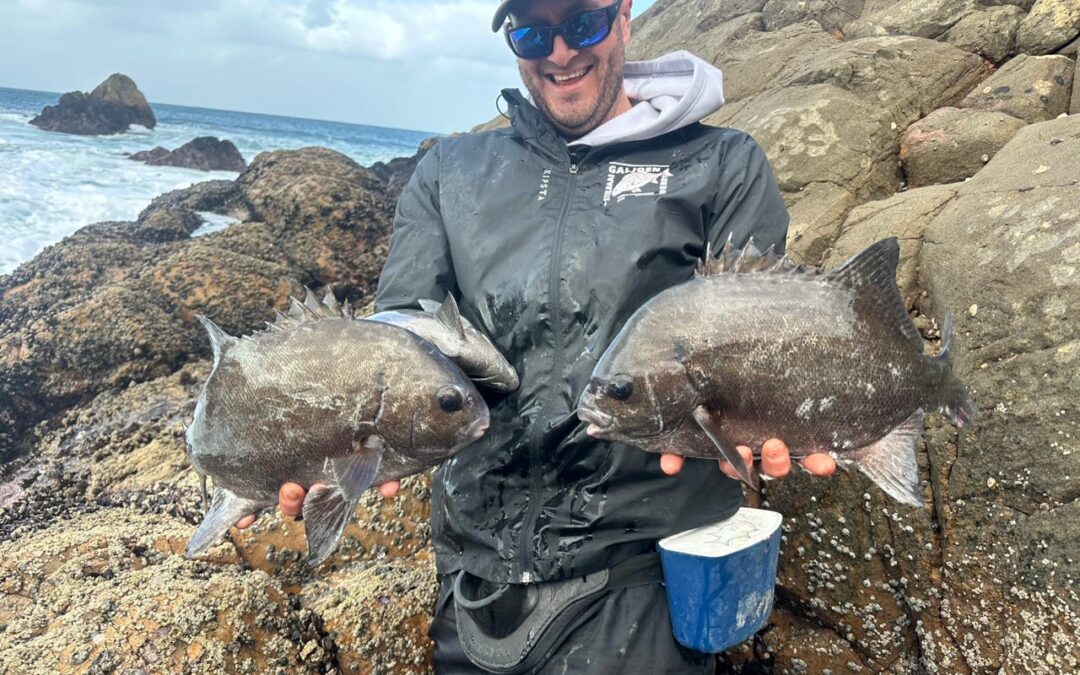
Look for galjoen in foamy white water created by winter winds. Target scoured holes and reef edges where black mussels have washed out (these are usually active feeding zones.)
Rocky reefs with mixed sand and rock provide ideal habitat. Galjoen like areas with good kelp cover and access to their primary food sources. When casting from the beach, watch for exposed gullies after big swells.
Where to Find Galjoen
There are usually two parts to a Galjoen season. The first half of the season the seas are generally more stable, water temperatures are warmer and water tends to be a little cleaner.
And the other half the season the surf zone becomes a world of chaos as our coast is hammered by large storms moving in from the South. In the Summer and Autumn you will have bouts of churned up seas that favour the preferred feeding conditions for Galjoen, but you should also prepare to fish for them with a fairly different mindset until those classic big winter seas pull in.
Very few people know that a substantial portion of our Galjoen stock holds far offshore during the warmer months. The outer reefs of Skipskop, the 5 mile and 12 mile of Struis can host these fish in their thousands and often spear fisherman encounter these spectacular shoals during summer dives.
The inshore fish will more often than not be tightly hugged on rocky coastlines where food is in greater abundance. Their slim bodies may suggest that their feeding is somewhat suppressed during the summer months.
So our tip is to go look for them along rocky shores where wave action dislodges or reveals their preferred baits. Early mornings and late afternoons are best in these fair weather conditions and fish are undeniably drawn to working whitewater zones.
Pushing tide on the spring can yield great results as fish push in to feed on withered, exposed or detached baits. Your best bites often happen on a rock that you are about to be washed off of, so please be careful when fishing against a rising tide and know your exits well.
Generally speaking, during the summer months the South Easterly has silted up most of the reefs along sandy shores where Galjoen tend to thrive during our winter months. As the season turns and our Cape winter begins to bare its teeth, large swells pound our coast, washing away the summer layers of sand that have been covering hidden reefs for months on end.
These hidden reefs are unveiled by these stormy sea’s, revealing with it all that a Galjoens diet consists of. It’s like a winter market, just for Galjoen. Soft shelled redbait or Sand Aas pods have been buried for months, some have died and host cured bait that Galjoen simply can’t resist. Crustaceans, Purple bait, mussels and various worms species are exposed with large swells hammering the coast and this is when the magic migration starts to happen.
Galjoen make their way into the rock and surf zones in numbers. Imagine the underwater scent of metric tonnes of rotting redbait rolling around in the surf? The offshore fish are drawn inshore to indulge in the amassed bait which starts accumulating or become exposed during these winter storms.
The attentive angler will feel the arrival of these offshore shoals as they migrate inshore into sandy coastal areas to feed on newly opened reefs. The reefs are washed open or “oop gespoel” and can at times be visible from shore.
You will identify these zones by looking for tufts of sand puffing up, swirling or turbulent water as swells roll over broken structure or even a deep waveless gutter on a surf. Attempt to fish as close as possible to these bait factories.
Be the first angler on one of these newly revealed sections of reef and you might be rewarded with significant success. The rocky areas will still hold great fish as redbait and black mussels are dislodged by stormy sea’s, but fish may tend to hold in specific areas and be less widespread.
Best Baits for Galjoen
Bait choice can make or break your session.
Remember the two parts of the season we discussed ? Let’s go back to that for a second.
A galjoen rarely if ever rejects quality White Mussel or Red Bait, as long as you have those two baits you should be able to find them. But summer/Autumn fish can have a slightly different taste for Red Bait and their diets are slightly different to the mid winter monsters we love so much.
Warmer cleaner waters means these fish may have been zoned in to certain baits, feeding more on sight than scent. Black mussel and Red Crab can be lethal baits during early season sessions. Large galjoen are often zoned in on large red crabs during summer months and when fishing crab baits, there’s always the chance of the ever present White Musselcracker or even White Steenbras.
Crabs are best fished when collected directly off the rocks and straight onto the hook instead of frozen or pre caught. Don’t be scared to cut them up and try your own Frankenstein versions, you’d be amazed at how well that works.
Curing redbait for this time of year can be done but keep in mind, there is no need to over do it. Fresh redbait can work a charm especially if it’s “Sand Aas” and when curing, a day or two at most should do the trick. Soft to touch, slight discolouration, fruity tone. March, April and May these fish have no problem eating fresh bait and over the years we have even found them in certain areas to prefer the fresher stuff.
White mussel is also a firm favourite along the Overberg coast. And worms, well worms are worms and when they are fresh they rarely lose their mojo.
As soon as the storms start pounding our coast, visibility drops, water temperatures drop, oxygen increases and that’s when you want to focus on prepping your cured red bait. Imagine trying to find a rugby ball in a heavy dust storm. Blinded by the chaos, you’d probably have a much better chance of finding it if it was a well scented redbait ball. You get the point…
Other baits include Sand Prawn, Blood Worm, Moonshine worm, Wonderworm, Purple bait, Sand Crab, Crayfish tail, Oysters and even Pencil bait. And yes there are a few other secret baits…
Essential Fishing Tackle Setup for Galjoen Fishing
The right fishing tackle setup is critical for landing galjoen in rough conditions. Here’s what you’ll need:
Rods
There are anglers who enjoy scratching with 10-13 ft fast-action surf rod, but the Western Cape coastline generally demands a 14ft setup. FG Tackle offers excellent options like the Assassin Bluefish Zero engineered specifically for shore fishing in South Africa’s challenging conditions. Fishing with a 14ft rod radically opens up new zones to fish that 10-13ft setups may struggle to fish over or through.
Line clearance can become extremely important when targeting larger specimens, especially when pulling them from a distance. 10-13ft setups should be considered as close quarter combat tools for scratching gullies and nearby structure. If you have the budget for one rod, try aim for a 14ft rod that can do it all. Summer comes and you have a great rod for Steenbras and kob too !
Reels
Pair your rod with a sturdy spinning reel featuring a strong drag system. Grinder-style reels work well. The PENN Slammer IV[a] and Shimano Saragosa SW A[b] are built for saltwater abuse and have the capacity to handle bigger galjoen and bycatch like Cracker and Steenbras. 6000-8000 spool sizes are best.
Line and Leader
Spool 20-40 lb braided line for sensitivity and strength. We stock JDB 8X DNA braid and many other braids in these ratings. Although braid leaders aren’t always necessary and ca contribute to drag in washy zones, an 80lb braid leader could very well help you land an outsized trophy fish. Our Triple Fish Rhino Braided Surf Leader[c] is designed for exactly this purpose.
Learn to balance your rig with these FG Tackle setup examples.
Light tackle setup
20lb main line
60lb braid leader or straight to .57/.60
.57 / .60 leader
.55-.60 hook snoot
.40 sinker Trace
General Galjoen setup
30lb mainline
80lb braid leader or straight to .60 / .65 mono
.60 – .65 hook snoot
.47 – .50 sinker trace
The “I don’t like to do FG knots” trace setup
Good for targeting large Galjoen around oyster banks and mussel beds with the presence of Musselcracker.
40lb mainline
80lb braid leader or straight to .65 / .70 mono
.65 / .70 hook snoot
.50 / .55 sinker trace
Final tip. When Galjoen are feeding, they are most certainly not line shy. They eat bait off 10 ton boulders, we doubt .70mm of see through mono will deter the bite if the bait is right.
Hooks
Circle hooks have become increasingly popular with Galjoen fisherman. A little secret is to pair circle hooks with a soft action rod and then to simply let them eat, they ultimately hang themselves with minimal persuasion from the angler. This combination has revolutionised the way Galjoen anglers fish. We stock a range of soft action rods specifically suited for edibles.
So what’s our favourite picks ?
1.) BKK Hybrid Heavy Circle SS
2.) Trident Kobu
3.) SSH Hybrid Circle
4.) SSH inline circle
5.) BKK Heavy Glow
Sinkers
Bottle sinkers, wire sinkers, cones and planes, it’s up to the angler here. Naturally bottle sinkers are where it’s at but some anglers swear by fishing a wire sinker on sandy stretches. Each to their own, that’s we stock the full range.
FG Tackle wishes you a happy 2026 Galjoen season !